Delhi Air Pollution: 2 Permanent GRAP Vehicle Curbs Imposed
Delhi is once again grappling with dangerously unhealthy air, as its Air Quality Index (AQI) continues to hover in hazardous zones. On December 27, 2025, the city’s AQI hit 390 at 6 PM, a level officially categorized as ‘Very Poor’ by the Central Pollution Control Board (CPCB). This ongoing crisis has pushed the Delhi government […]
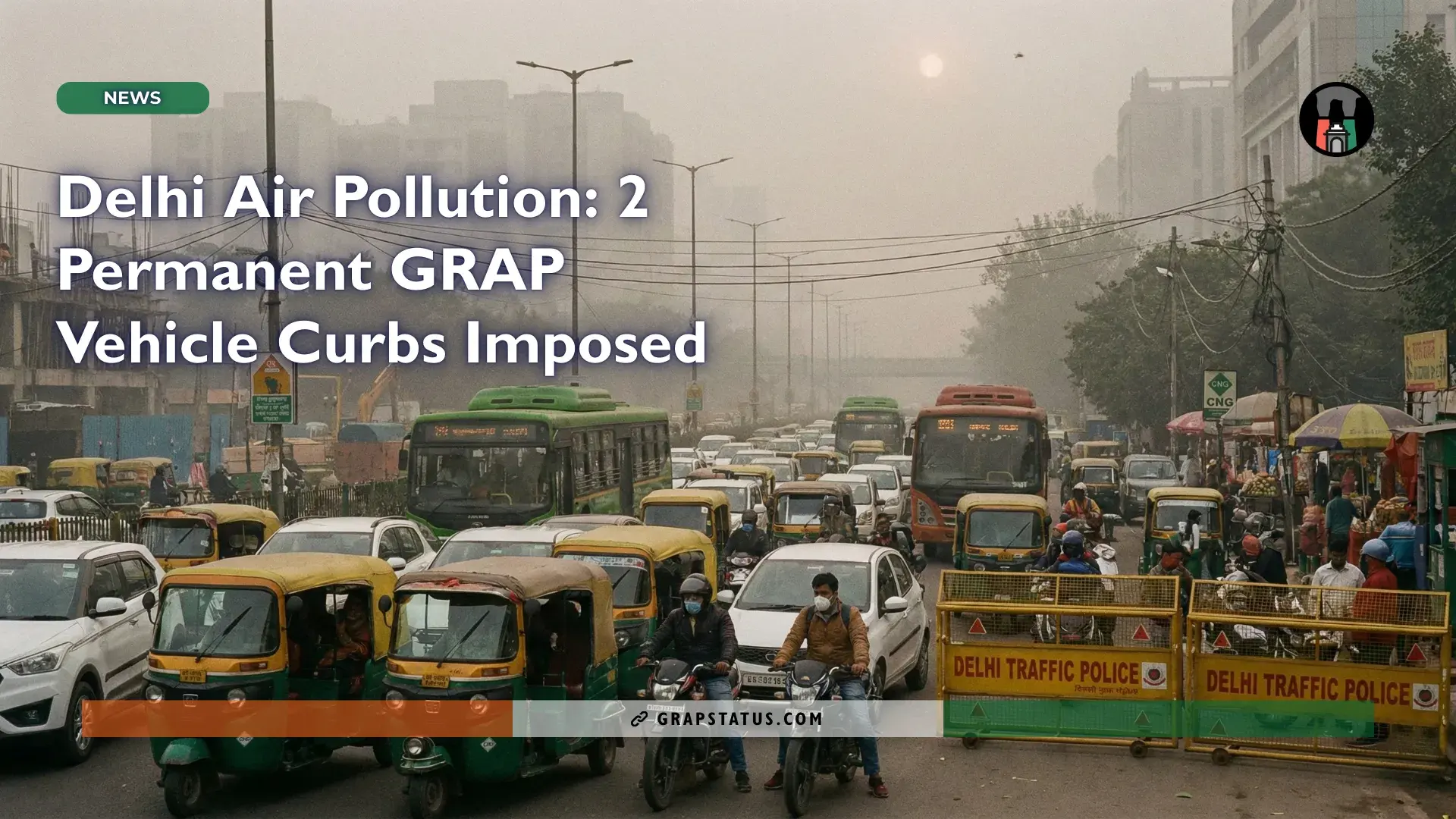
Delhi is once again grappling with dangerously unhealthy air, as its Air Quality Index (AQI) continues to hover in hazardous zones. On December 27, 2025, the city’s AQI hit 390 at 6 PM, a level officially categorized as ‘Very Poor’ by the Central Pollution Control Board (CPCB). This ongoing crisis has pushed the Delhi government to take a bold and decisive step: implementing two permanent vehicle restrictions under the Graded Response Action Plan (GRAP)-4. This move signals a significant shift in Delhi’s fight against pollution, moving away from temporary, seasonal fixes towards year-round, non-negotiable enforcement, regardless of daily air quality fluctuations.
These new measures are specifically designed to target vehicles that contribute most to air pollution, focusing on essential checks like the Pollution Under Control Certificate (PUCC) and stricter Bharat Stage VI (BS6) emission standards. Environment Minister Manjinder Singh Sirsa announced these changes on December 27, 2025, following a cabinet meeting led by Chief Minister Rekha Gupta. The goal is clear: to systematically reduce emissions from vehicles, which are a major culprit in Delhi’s toxic air, especially during the colder months when smog often blankets the city. This proactive approach aims to prevent future pollution spikes rather than just reacting to them.

What Are Delhi’s New Permanent Anti-Pollution Rules?
The Delhi government has introduced two key rules that will now be active permanently, replacing their previous status as emergency measures. These rules aim to tackle pollution at its source by regulating the vehicles that operate within and enter the city.
Rule 1: No Fuel Without a Valid Pollution Under Control Certificate (PUCC)
The first major restriction mandates that all petrol pumps across Delhi must refuse to sell fuel – whether petrol or diesel – to any vehicle that does not possess a valid Pollution Under Control Certificate (PUCC). This rule is a game-changer because, until now, it was only activated during the most severe stages of air pollution under GRAP-4. Now, it is indefinite and will remain in force until further notice.
A PUCC is a document that confirms a vehicle meets the required emission limits set for pollutants like carbon monoxide (CO), hydrocarbons (HC), and tiny particulate matter (PM). To get a PUCC, vehicles undergo specific tests. For two-wheelers and three-wheelers, tests are done while simulating acceleration on a special rolling road called a chassis dynamometer. For four-wheelers, tests are performed in idle or load modes. These tests make sure that diesel vehicles have opacity (smoke levels) below 65-75 Hartridge Smoke Units (HSU) and petrol vehicles have CO levels below 0.3-3%, depending on their age and fuel type. Minister Sirsa has strongly stated that non-compliant vehicles are “committing a crime against Delhi’s air,” highlighting their role in increasing harmful PM2.5 and nitrogen oxide (NOx) levels, which make Delhi’s winter smog much worse.
Rule 2: No Entry for Out-of-State Non-BS6 Vehicles
The second permanent rule bans all out-of-state vehicles that do not meet Bharat Stage VI (BS6) emission standards from entering Delhi. This restriction is effective immediately and will not be lifted seasonally. It specifically targets traffic coming from other states, which often brings in emissions from less-regulated areas, contributing to Delhi’s air woes.
BS6 standards are the toughest emission norms in India, equivalent to Euro VI standards, and were implemented nationwide from April 2020. These standards set very strict limits for pollutants. For light-duty diesel vehicles, the limits are 0.0045 grams per kilometer (g/km) for PM, 0.08 g/km for NOx, and 0.17 g/km for combined HC+NOx. For petrol vehicles, the limits are 1.0 g/km for CO, 0.10 g/km for HC, and 0.06 g/km for NOx. These strict limits are achieved through advanced technologies like Selective Catalytic Reduction (SCR), Exhaust Gas Recirculation (EGR), and Diesel Particulate Filters (DPF), along with Onboard Diagnostics (OBD) for real-time pollution monitoring. The BS6 norms represent a huge leap from older standards like BS4 (Euro IV), reducing PM emissions by 82% and NOx emissions by 70% in diesel vehicles. This is especially important for Delhi, as millions of pre-BS6 vehicles from neighboring states frequently enter the city, contributing to the transboundary pollution problem.
Why Are These Rules Being Made Permanent?
The decision to make these vehicle restrictions permanent reflects the severe and ongoing nature of Delhi’s air pollution crisis and a strategic shift by the government towards long-term solutions.
The Severity of Delhi’s Air Pollution Crisis
Delhi’s air quality regularly plunges into categories that pose immediate health risks. An AQI of 390, classified as ‘Very Poor,’ means the air is significantly polluted. When the AQI reaches the ‘Severe’ category (401-500), it becomes immediately dangerous, causing severe respiratory distress, worsening asthma, and putting a strain on the hearts of even healthy adults. In such conditions, the concentration of PM2.5 can exceed 250 micrograms per cubic meter (µg/m³), and PM10 can go above 430 µg/m³. These tiny particles are particularly dangerous because they can penetrate deep into the lungs, enter the bloodstream, and lead to serious health problems like stroke, lung cancer, and even premature births.
Vehicular emissions are a major contributor to this problem, accounting for 20-30% of Delhi’s PM2.5 during winter months, according to CPCB data. Diesel vehicles, especially older trucks and cars, are a particular concern as they emit black carbon and ultrafine particles that are highly detrimental to health. These emissions, combined with unfavorable weather conditions like low wind speeds (below 5 km/h), temperature inversions that trap pollutants in a low layer of air, and stagnant air masses caused by upcoming Western Disturbances, create a deadly cocktail of pollutants.
Moving Beyond Emergency Measures: A Proactive Shift
Historically, Delhi has relied on the Graded Response Action Plan (GRAP), which escalates measures based on AQI levels. GRAP Stage 1 (Poor, AQI 201-300) involves inspections, Stage 2 (Very Poor, 301-400) bans coal usage, Stage 3 (Severe, 401-450) closes schools, and Stage 4 (Severe+, >450) halts non-essential activities. However, these new permanent curbs represent a fundamental change. They are designed to operate independently of the GRAP stages, meaning they are always active, regardless of the daily AQI reading.
This strategic shift aims to move from simply reacting to pollution peaks to proactively preventing them. The Delhi government, as formalized in the cabinet meeting, is committed to a “sustained strategy to phase out older, dirtier engines” that lack the technology to capture fine particles or reduce NOx through advanced catalytic converters and diesel particulate filters. This policy signals Delhi’s strong pivot towards “proactive emission governance” as it faces recurring air pollution crises, hoping to achieve lasting improvements rather than temporary relief.
How Will These New Restrictions Be Enforced?
Putting these permanent rules into action requires a robust enforcement mechanism across the city and at its borders. The Delhi government has outlined clear methods for ensuring compliance.
PUCC Checks at Fuel Stations
For the PUCC rule, petrol pump operators in Delhi are now key enforcers. They are required to verify a vehicle’s PUCC status using digital scanners that are directly linked to the Parivahan portal, a national database for vehicle information. This digital system ensures quick and accurate checks. Any vehicle found without a valid PUCC will be denied fuel. Violations of this rule can lead to significant penalties, with fines of up to ₹10,000 as per amendments to the Motor Vehicles Act. This direct control at the point of fuel dispensing is expected to significantly improve PUCC compliance rates among Delhi’s more than 10 million registered vehicles.
BS6 Compliance at Delhi’s Borders
Enforcing the ban on non-BS6 out-of-state vehicles entering Delhi will involve a dedicated effort at all entry points. The authorities plan to deploy over 200 teams equipped with emission analyzers at Delhi’s borders. These teams will conduct checks to ensure that incoming vehicles comply with the BS6 emission standards. While the Supreme Court has previously issued clarifications on actions against older vehicles (like banning pre-BS-IV vehicles and protecting end-of-life petrol cars over 15 years and diesel cars over 10 years), the new permanent policy firmly puts the focus on BS6 compliance for all incoming inter-state traffic. This means that even if an older vehicle from a neighboring state meets its local emission norms, it will be denied entry into Delhi if it does not meet BS6 standards. This measure is crucial for stopping transboundary pollution from less-regulated regions.
What Are the Expected Outcomes and Challenges?
The implementation of these permanent vehicle restrictions is a significant step, carrying both high hopes for cleaner air and the reality of ongoing challenges in Delhi’s complex fight against pollution.
Projected Improvements and Long-Term Goals
Authorities are optimistic about the impact of these measures. They project that with strict compliance, the city’s fleet-average emissions could be reduced by a substantial 40-50% over the next five years. This reduction is expected to help stabilize the Air Quality Index (AQI) below the 300 mark, moving Delhi away from the ‘Very Poor’ and ‘Severe’ categories that are so damaging to public health. The new rules also work hand-in-hand with other existing initiatives, such as incentives for electric vehicles and mandates for Compressed Natural Gas (CNG) usage, creating a multi-faceted approach to emission control. This long-term mechanism is part of a broader strategy to systematically clean Delhi’s air for good.
Persistent Challenges and Potential Risks
Despite the promising projections, several challenges remain that could hinder the full success of these policies. Air pollution in Delhi is a complex problem with multiple sources. Stubborn factors like stubble burning in neighboring states continue to contribute significantly, sometimes up to 30%, to Delhi’s PM2.5 levels. Industrial dust and other local emission sources also play a role. Furthermore, ensuring complete adherence to these new rules across a vast region with millions of vehicles, along with fluctuating inter-state traffic, will be a massive enforcement task. Non-adherence to these permanent curbs could force the government to reactivate other GRAP-4 measures, such as the odd-even car rationing scheme and bans on construction activities, which cause significant public inconvenience.
The Role of Weather in Delhi’s Air Quality
Adding to the complexity, weather conditions play a critical role in how severe pollution becomes. During winter, Delhi often experiences calm winds, with speeds frequently below 5 kilometers per hour, which prevents pollutants from dispersing. Temperature inversions, where a layer of warm air traps cooler, polluted air close to the ground within a 1-2 kilometer boundary layer, further worsen the situation. Forecasts of impending Western Disturbances can also contribute to stagnating air masses, holding pollution over the city for longer periods. Environment Minister Sirsa emphasized the importance of continuous weather monitoring, as calm winds combined with high humidity (often over 70%) create ideal conditions for the formation of “secondary aerosols” from pollutants like nitrogen oxides (NOx) and volatile organic compounds (VOCs), which greatly increase the concentration of fine particulate matter in the air.
In conclusion, Delhi’s new permanent vehicle restrictions mark a significant and necessary shift in the city’s approach to air pollution. By moving from reactive, emergency-based measures to proactive, year-round enforcement, the government is signaling its deep commitment to tackling this persistent health crisis. These measures, focusing on PUCC compliance and BS6 standards, are vital steps towards phasing out high-emission vehicles and curbing imported pollution. While challenges from other pollution sources and the ever-present influence of weather will continue to test Delhi’s resolve, the success of these permanent curbs ultimately rests on strong enforcement and the collective cooperation of every citizen and vehicle owner. The fight for clean air in Delhi is far from over, but these new rules offer a glimmer of hope for a healthier future.