GRAP IV (Stage 4): Updated Restrictrions & What You Need to Know?
Delhi and the National Capital Region (NCR) often find themselves battling a severe health crisis as winter arrives: dangerously high air pollution. When the Air Quality Index (AQI) climbs above 450, reaching the “severe plus” category, a strict set of emergency rules, known as GRAP Stage IV, kicks in. This isn’t just a suggestion; it’s […]
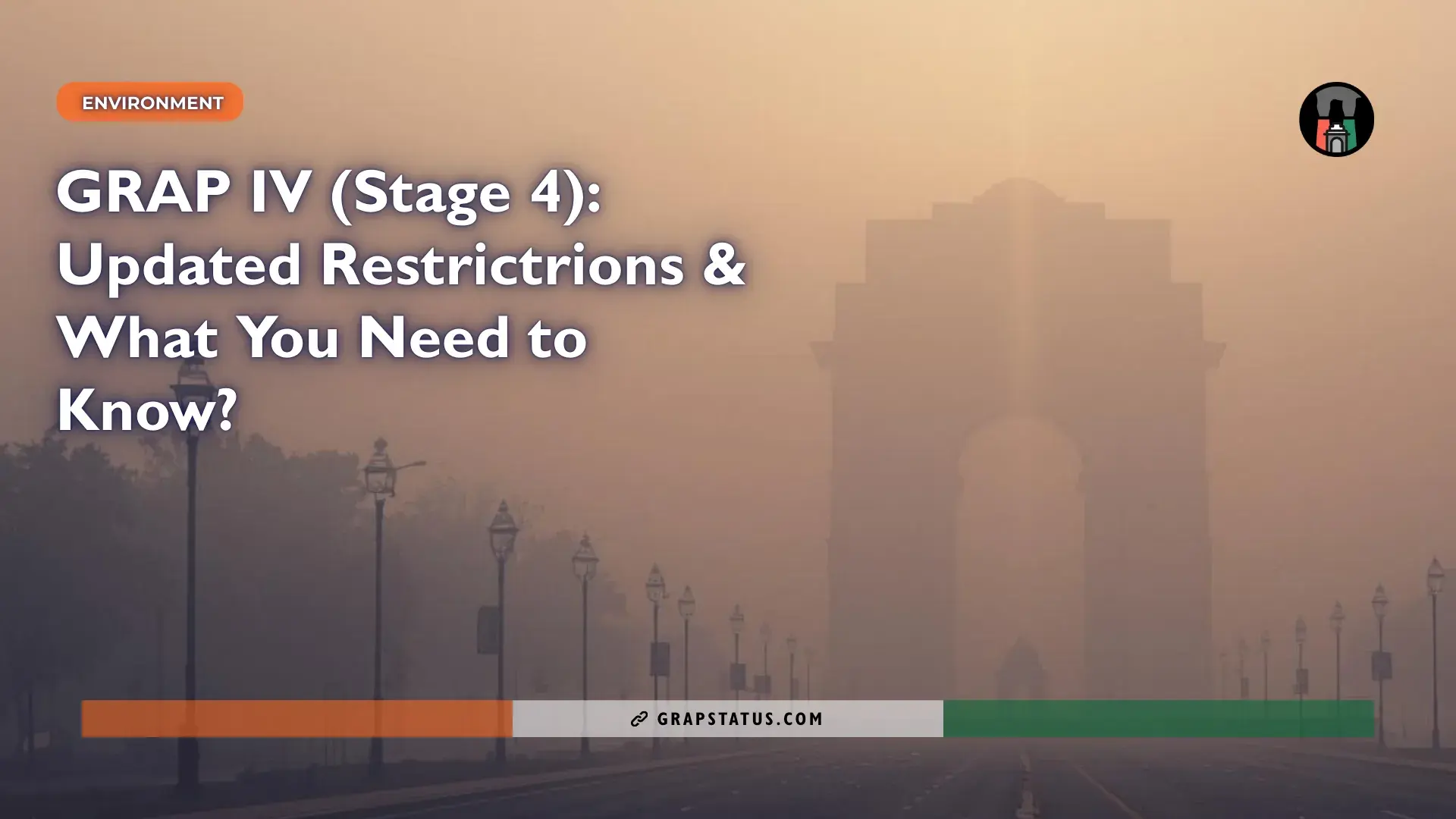
Delhi and the National Capital Region (NCR) often find themselves battling a severe health crisis as winter arrives: dangerously high air pollution. When the Air Quality Index (AQI) climbs above 450, reaching the “severe plus” category, a strict set of emergency rules, known as GRAP Stage IV, kicks in. This isn’t just a suggestion; it’s a life-saving plan designed to drastically cut down pollution sources and protect people from the harmful effects of extremely dirty air.
The Graded Response Action Plan (GRAP) is a four-stage system that the government uses to fight air pollution. Each stage has specific actions to take based on how bad the air quality is. GRAP Stage IV is the most serious, activated only when the AQI hits critical levels of over 450. This means the air is extremely dangerous to breathe, posing severe risks to everyone’s health.
Why is GRAP Stage IV Necessary?
The AQI exceeding 450 is not a minor issue. It signifies an emergency situation for public health. At these levels, PM2.5 concentrations can be more than 20 times the safe limit. Breathing this air can lead to:
- Immediate health issues: Coughing, wheezing, shortness of breath, and irritation of the eyes, nose, and throat.
- Worsening of chronic diseases: People with existing heart or lung problems, such as asthma, bronchitis, or cardiovascular disease, are at high risk of severe attacks.
- Long-term risks: Prolonged exposure can increase the chances of developing serious illnesses, including lung cancer and heart disease.
Children, the elderly, and individuals with pre-existing health conditions are particularly vulnerable. GRAP Stage IV is put in place to quickly reduce the pollution levels and safeguard these vulnerable groups. The urgency of such action becomes clear when you consider how quickly AQI can swing from “poor” to “hazardous,” as highlighted in recent occurances like “Delhi AQI Worsens: Air Quality Plunges Day After GRAP-3 Removal”, where a brief relaxation in curbs led to a rapid spike in pollution.

The Eight-Point Action Plan Under GRAP Stage IV
When GRAP Stage IV is invoked, a series of strict measures are put into effect across Delhi and the NCR. These actions aim to significantly reduce emissions from major pollution sources: vehicles, construction, and industries. It’s important to remember that all the measures from Stages I, II, and III also remain in place.
Here are the key actions taken during GRAP Stage IV:
1. Trucks Face Entry Restrictions
To cut down on traffic emissions, all trucks are banned from entering Delhi. There are a few exceptions: trucks carrying essential goods like food and medicines, and those providing essential services such as waste management. Trucks running on cleaner fuels like LNG, CNG, or electric trucks, and BS-VI diesel trucks are also allowed.
2. Restrictions on Light Commercial Vehicles (LCVs)
LCVs, which are smaller commercial vehicles, registered outside of Delhi are also banned from entering the city. Similar to trucks, there are exemptions for LCVs carrying essential items or providing vital services. Again, electric, CNG, or BS-VI diesel LCVs are permitted.
3. Ban on Older Diesel Vehicles in Delhi
Heavy and medium goods vehicles registered in Delhi that run on diesel and meet older emission standards (BS-IV or below) are strictly prohibited. They are only allowed if they are carrying essential goods or providing necessary services. This targets some of the older, more polluting diesel engines.
4. Construction and Demolition Work Halted
Construction and demolition (C&D) activities are a major source of dust pollution. During Stage IV, all such activities are completely stopped. This ban extends even to essential public projects like highways, roads, flyovers, and pipelines. The aim is to prevent dust from becoming airborne and adding to the PM2.5 levels.
5. Educational Institutions Shift to Online Learning
To protect students, schools in Delhi and the NCR are authorized to shift classes for students from Grade VI to IX and Grade XI to an online learning format. Colleges and other higher education institutions might also be closed entirely, with learning moving online. This reduces the need for students to travel and minimizes their exposure to polluted outdoor air.
6. Reducing Office Attendance
To decrease the number of vehicles on the road, governments in Delhi and the NCR can mandate that public, municipal, and private offices operate with only 50% of their staff physically present. The remaining 50% are required to work from home. The central government can also issue similar directives for its employees.
7. Additional Emergency Measures Considered
In extreme situations, state governments might consider even more drastic steps. These can include closing non-essential commercial businesses or implementing the “odd-even” vehicle rationing scheme. Under this scheme, vehicles with odd-numbered license plates can only drive on certain days, and those with even-numbered plates on other days. This was used in the past to cut down traffic significantly.
8. Citizen Responsibility Encouraged
The public is also urged to play their part. This includes avoiding unnecessary travel, reducing the use of personal generators (which also emit pollutants), and following all advisories issued by health authorities.
How GRAP Works and Recent Changes
The GRAP system is managed by the Commission for Air Quality Management (CAQM) in the National Capital Region. Its sub-committee closely monitors the AQI based on data from the Central Pollution Control Board. They can activate GRAP stages preemptively, meaning they might bring in stricter rules even if the AQI hasn’t quite crossed the threshold yet, if they see the pollution trend is worsening rapidly.
Recent updates to the GRAP schedule have made the system more proactive. For instance, some measures that were previously applied at Stage IV are now activated at Stage III (AQI 401-450), and even earlier at Stage II (AQI 301-400). This means that by the time AQI crosses 450 for Stage IV, many rules are already in place, helping to curb pollution faster. These changes are part of a wider overhaul explained in detail in “GRAP 2025 Changes: A Better Approach for Delhi-NCR to Combat Air Pollution”, where earlier triggers and stricter controls are introduced to prevent AQI from spiralling into the “severe plus” zone.
Understanding the Technical Details
The effectiveness of these measures often relies on vehicles meeting specific emission standards. BS-VI refers to Bharat Stage VI emission norms, which are equivalent to Euro VI standards. These norms significantly reduce pollutants like Nitrogen Oxides (NOx) and Particulate Matter (PM) by using advanced technologies in vehicles.
Essential services are often prioritized for vehicles running on cleaner fuels like CNG, LNG, or electricity. These fuels generally produce much lower levels of tailpipe emissions compared to traditional diesel or petrol.
The decision to implement or lift GRAP stages is based on the 24-hour average AQI. For Stage IV measures to be lifted, the AQI needs to stay below 450 for a sustained period, and then drop to Stage III levels (401-450). Violating these rules can lead to significant fines under the Air (Prevention and Control of Pollution) Act of 1981.
The Impact on Health and the Environment
Studies have shown that actions like the GRAP Stage IV ban on vehicles can reduce vehicular dust contributions by a significant percentage, sometimes between 30-40% in past episodes. However, the full success of GRAP depends on all states in the region working together closely.
The challenge is balancing these necessary public health interventions with the economic impacts. For example, halting all construction work can have substantial financial consequences. Yet, the health risks associated with severe air pollution, including increased hospital admissions for respiratory and cardiovascular problems, are undeniable.
Delhi NCR is a major hub for vehicular emissions, which contribute heavily to the region’s air pollution problem. GRAP Stage IV, while a drastic measure, is a critical tool in the fight to make the air breathable and protect the health of millions living in the region. It’s a stark reminder of the urgent need for long-term solutions to address the root causes of air pollution, beyond just emergency responses.