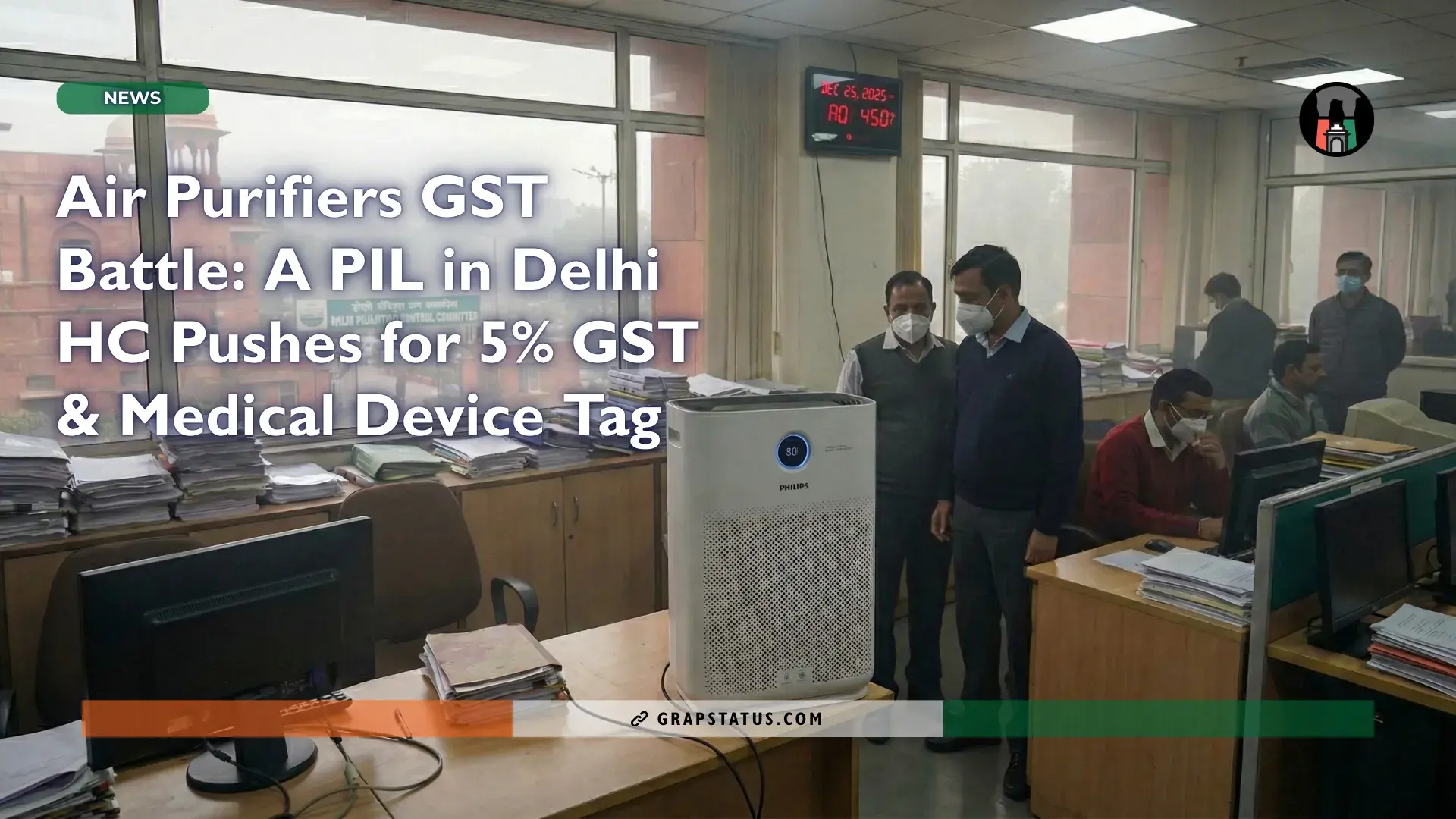
Air Purifiers GST Battle: A PIL in Delhi HC Pushes for 5% GST & Medical Device Tag
Here in Delhi NCR, the fight for clean air is a daily reality. We all know the drill: the AQI numbers creep up, the haze thickens, and our lungs feel the strain. It’s not just an inconvenience; it’s a genuine public health crisis, an “extreme emergency,” as recent legal arguments rightly put it. So, when […]
Here in Delhi NCR, the fight for clean air is a daily reality. We all know the drill: the AQI numbers creep up, the haze thickens, and our lungs feel the strain. It’s not just an inconvenience; it’s a genuine public health crisis, an “extreme emergency,” as recent legal arguments rightly put it. So, when something promises a glimmer of hope in this suffocating battle, it’s worth paying close attention.
That’s exactly what’s happening now in the Delhi High Court. A public interest litigation (PIL) has been filed, asking the government and the GST Council to do something that just makes plain sense: classify air purifiers as “medical devices” and slash their Goods and Services Tax (GST) rate from a hefty 18% down to a much more affordable 5%. This isn’t just about saving a few bucks; it’s about making essential health protection accessible to everyone who lives and breathes in our polluted cities.
The PIL, moved by advocate Kapil Madan, challenges the current system that treats air purifiers like fancy gadgets or “luxury household appliances.” If you’ve ever felt your chest tighten during a bad air day, you know an air purifier is anything but a luxury. It’s a necessity, a shield against the invisible enemies in the air, especially for our kids, our elders, and anyone with a respiratory challenge. This legal battle is crucial because it aims to align our tax system with the stark reality of our environment and public health needs.

The Battle for Breath: Why Air Purifiers Aren’t a Luxury Here
Let’s be honest, living in Delhi NCR means constantly facing air pollution that regularly hits hazardous levels. We’re talking about air choked with tiny, dangerous particles like PM2.5 and PM10, along with other toxic substances. These aren’t just statistics; they’re direct threats to our health. They seep into our lungs, our bloodstream, and wreak havoc on our bodies. Respiratory illnesses like asthma, chronic obstructive pulmonary disease (COPD), and bronchitis become more common and severe. Even our hearts suffer, with increased risks of cardiovascular problems.
For many families, especially those with vulnerable members like young children whose lungs are still developing, or grandparents with pre-existing conditions, an air purifier isn’t a “nice-to-have.” It’s a “must-have.” It’s a tool that actively reduces the particulate pollution and airborne contaminants inside our homes, giving us a vital refuge from the toxic outdoor air. When outdoor air quality is an “extreme emergency crisis,” as the petition accurately describes, relying on nature to clean the air is simply not an option. We need active protection, and indoor air purification provides that.
Think about it: during peak pollution season, doctors often advise patients, particularly those at risk, to stay indoors and use air purification devices. This isn’t for comfort; it’s for survival and disease prevention. To label such a device as a “luxury” item, therefore, just doesn’t make sense in our context. It completely ignores the severe health burden that air pollution places on millions of people living in Delhi NCR.
A Legal Loophole? The 2020 Medical Device Notification
Now, let’s dive into the core of the legal argument. The PIL points to a crucial piece of government action that, surprisingly, might already pave the way for this change. On February 11, 2020, the Central Government issued a notification under the Drugs and Cosmetics Act, 1940. This wasn’t just any old update; it was a game-changer for how “medical devices” are defined.
Before this notification, the definition was quite narrow, often listing specific items. But the 2020 notification threw the doors wide open. It expanded the definition to be much broader and, importantly, “purpose-based.” This means it focuses on what a device *does*, rather than just what it *is*. Here’s how it changed things:
- It includes “any instrument, apparatus, appliance, implant, material, software or accessory.”
- This device must be “intended for the prevention, diagnosis, monitoring or alleviation of disease.”
- Crucially, it covers devices regardless of “whether it functions by pharmacological, immunological, metabolic, mechanical or other non-pharmacological means.”
See where this is going? The petitioner argues that air purifiers fit this expanded definition perfectly. Why? Because they are appliances intended to *prevent or alleviate disease and health impairment* that are caused or made worse by polluted air. They work by *mechanical* means (filters, fans) to reduce harmful pollutants. They actively serve a preventive and health-protective role, just like many other recognized medical devices that are used to manage or prevent health issues.
If a device that measures blood pressure is a medical device because it monitors health, and a nebulizer is a medical device because it alleviates respiratory distress, then an air purifier, which actively prevents and alleviates disease by removing pollutants from the air you breathe, should logically be in the same category. There’s no rational reason to treat them as mere consumer electronics when their primary function, especially in our polluted environment, is undeniably linked to public health.
The 18% Hurdle: Why High GST is Unfair and Unhealthy?
This is where the financial pinch comes in, and it hits hard. Currently, air purifiers are lumped into the 18% GST slab. This is typically reserved for non-essential goods and various electronic appliances. But if you compare that to most medical devices, which enjoy a much lower 5% GST rate, the difference is glaring. This 5% rate reflects a clear policy decision by the government: medical devices should be affordable, making them more accessible to people as part of public health support.
The PIL argues that this “differential tax treatment” is completely “arbitrary and unreasonable.” It’s not just an academic point; it has real-world consequences. An 18% tax significantly inflates the price of air purifiers, turning them into a luxury that many middle and lower income families simply cannot afford. Imagine needing an air purifier for your asthmatic child, knowing it could ease their suffering, but being unable to buy one because the government adds an extra 13% on top of the already significant cost.
This situation directly contradicts Article 14 of the Constitution of India, which guarantees equality before the law and prohibits arbitrary classification. The argument is simple: if other devices that prevent or mitigate health risks are taxed at 5%, why should air purifiers, which do the exact same thing in a critical public health emergency, be taxed at 18%? This higher tax rate “fails the test of intelligible differentia and rational nexus,” meaning there’s no logical difference or connection that justifies treating them so differently, especially when clean air is a matter of life and death for many.
It boils down to this: when the State can’t provide clean air (which it has a constitutional duty to do as part of the right to life), it absolutely should not create financial hurdles that prevent individuals from protecting themselves. High GST on air purifiers makes individual protective measures more expensive, making it harder for people to breathe safer air indoors. This is not just bad policy; it’s a public health disservice.
The High Court Steps In: A Glimmer of Hope
Thankfully, the Delhi High Court isn’t deaf to the cries of its citizens. The Court has “taken note” of the serious public health context and the strong plea regarding this irrational tax classification. This isn’t a small thing. When a court acknowledges the urgency and gravity of an issue, it sends a powerful message.
In fact, reports indicate that the Court has gone a step further. It has “called upon or directed the GST Council to consider lowering the GST on air purifiers” and urged them to treat the issue with “urgency.” The judges’ observations have reportedly been quite critical, emphasizing that “if the State cannot guarantee clean air, it must at least reassess fiscal policies that make protective devices more expensive.” This is a significant moment, as it clearly aligns the judiciary with the public’s need for accessible health protection.
The Court’s stance reflects a deep understanding of the problem. It recognizes that in a situation where the State is struggling to provide a basic necessity like clean air, it has a moral and legal obligation not to penalize citizens who try to protect themselves. This judicial push could be the catalyst needed to force a much-needed policy change, bringing relief to millions of Delhi NCR residents.
What This Means for You?
So, what does all this legal wrangling mean for you, the everyday person grappling with Delhi’s air? If this PIL succeeds, and the Delhi High Court’s directions are followed, it could lead to significantly more affordable air purifiers. Imagine being able to buy a quality air purifier without an extra 13% added to the price tag. This would make a huge difference for many families who are currently priced out of this essential health device.
This isn’t just about making one product cheaper; it’s about acknowledging the fundamental “right to life” which includes the right to breathe clean air. It’s about compelling the government to adopt fiscal policies that support public health, rather than hinder it. It’s a step towards treating air pollution as the health emergency it truly is, and providing tools for people to protect themselves when the ambient environment fails them.
The Right to Breathe Clean Air: A Fundamental Principle
The PIL invokes the larger principles of public health and the right to life. It argues that access to clean air is implicit in these fundamental rights. When the State cannot provide clean air, it must at least not impose financial barriers that prevent individuals from protecting themselves. High GST on air purifiers effectively creates a ‘pollution tax’ on personal protection, disproportionately affecting those with limited incomes, who are often most vulnerable to the health impacts of pollution.
This legal challenge is therefore not just about a tax rate or a product classification. It’s about holding the government accountable to its constitutional duties and ensuring that fiscal policies are aligned with the urgent public health needs of a region facing a severe air quality crisis. It is a powerful reminder that our right to a healthy life should not be undermined by arbitrary tax classifications.
In sum, this legal battle is built on solid ground: a new, broader definition of medical devices, the scientifically proven role of air purifiers in protecting health from pollution, and a constitutional challenge to an arbitrary tax rate that hurts public health. The Delhi High Court’s active engagement and its call to the GST Council mark a hopeful turning point. It reminds us that while the fight for clean air is long and hard, every step towards making protective measures more accessible is a victory for our health and our future. Let’s hope the GST Council listens and takes swift action to bring much-needed relief to the lungs of Delhi NCR.