What Are the New Vehicle Restrictions Imposed in Delhi NCR?: Check Details
Starting November 1 and running through January 31, a strict regional transport rule prohibits the entry of vehicles below Bharat Stage VI (BS-VI) emission standards into Delhi. This restriction policy is defined as a temporary travel prohibition designed to curb winter air pollution across the national capital region. Transport Department estimates indicate that more than […]
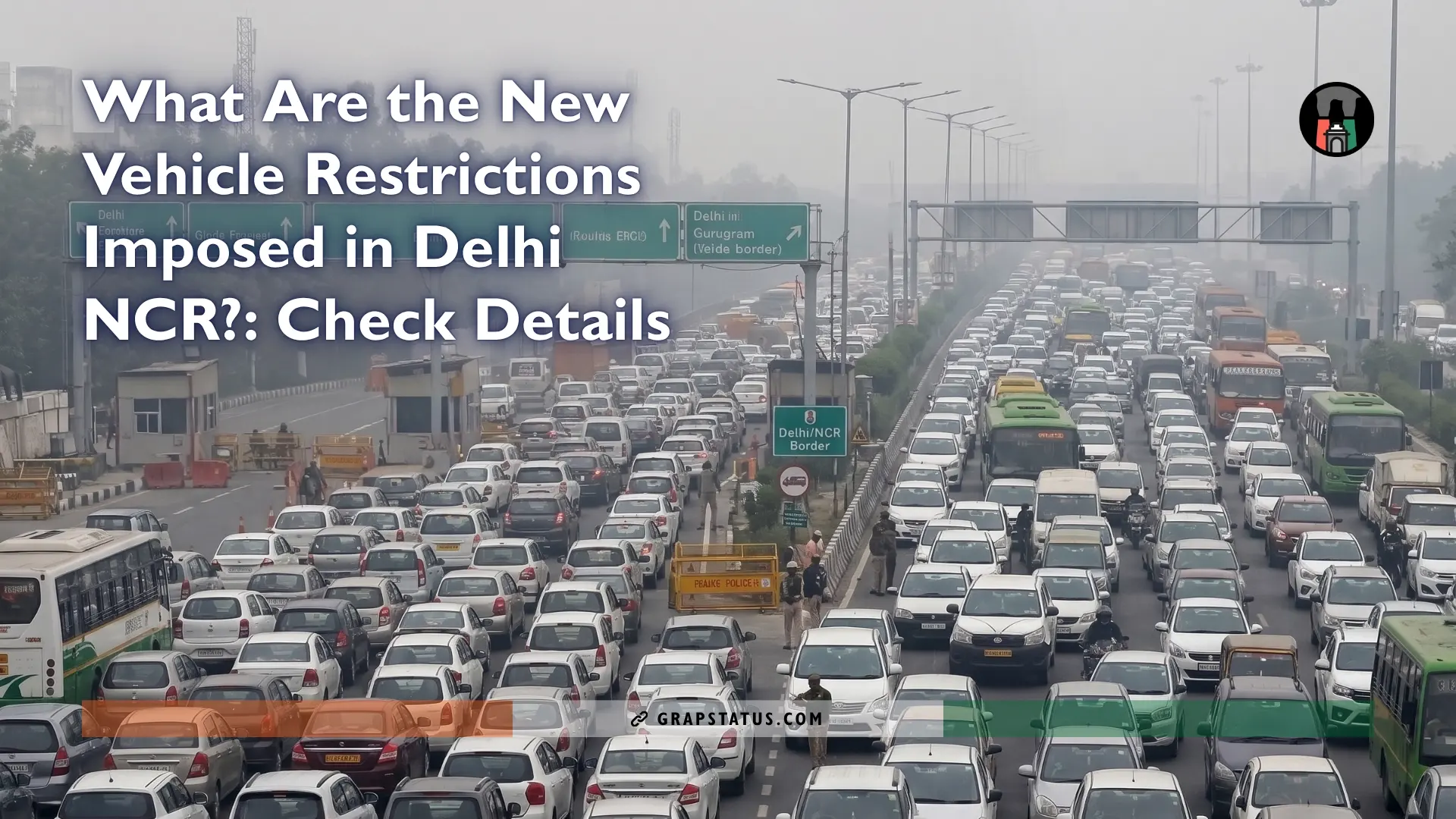
Starting November 1 and running through January 31, a strict regional transport rule prohibits the entry of vehicles below Bharat Stage VI (BS-VI) emission standards into Delhi. This restriction policy is defined as a temporary travel prohibition designed to curb winter air pollution across the national capital region. Transport Department estimates indicate that more than 10 lakh vehicles originating from neighboring satellite cities will be affected directly by these measures during the three months.
The restriction applies to all non-BS-VI private and commercial motor vehicles seeking border entry into the capital. By enforcing this standard during the three coldest months of the year, authorities aim to reduce toxic exhaust output during peak atmospheric stagnation. For commuters traveling from outer National Capital Region (NCR) hubs into central and western Delhi, these rules change everyday transit patterns substantially.

Which Regions and Commuters Are Affected by the Traffic Ban?
The geographic coverage of these vehicle restrictions spans five major urban districts surrounding Delhi. Drivers commuting from Gurugram, Faridabad, Noida, Greater Noida, and Ghaziabad face immediate disruptions if their personal or commercial transport falls below the BS-VI emission standard. According to transport sector reports, traveling for work, taking children to school, and completing daily household errands will present serious travel hurdles for thousands of families across these border zones.
Because thousands of workers cross regional borders daily to access metro stations, corporate parks, and educational institutes, the ban splits transit connections at the city line. Residents who rely on older vehicles to bridge the gap between suburban neighborhoods and urban workplaces must alter their primary routes or switch transport modes entirely before November 1.
- Gurugram: Heavy impact on daily commuters traveling across the Delhi-Haryana border toward Dwarka, Dhaula Kuan, and central business hubs.
- Faridabad: Disruption for drivers crossing south Delhi entry points for daily work and commerce.
- Noida and Greater Noida: Increased travel checks for vehicles crossing eastern border bridges over the Yamuna River.
- Ghaziabad: Strict entry reviews affecting commuters entering northeast Delhi corridors.
How Will Non-BS-VI Vehicle Restrictions Impact Daily Commuters?
For people living in surrounding NCR towns, the sudden restriction adds operational and financial burdens. A resident from Gurugram who drives to Dwarka every single day to drop his children off at school shared his frustration. His car is BS-IV-compliant and registered in Haryana. Speaking on the condition of anonymity, he questioned why responsible vehicle owners must suffer for a broader environmental crisis that the government has failed to control effectively over the years.
Other residents highlight the broader economic strain on families. Commuter Ravi Singh noted that the new order adds substantial recurring costs to monthly household budgets without addressing the primary root causes of winter air pollution. Furthermore, another Gurugram resident emphasized that these restrictions create severe daily difficulties for citizens who must cross the Delhi-Haryana border for routine family needs but lack the financial means to buy a new BS-VI vehicle on short notice.
Comparing Vehicle Emission Standards and Regional Impact
Understanding how the temporary ban separates compliant and non-compliant vehicles helps drivers assess their current travel readiness. The table below outlines the core differences in vehicle status, compliance requirements, affected locations, and the operational outcomes for everyday drivers.
| Vehicle Standard Category | Compliance Status | Affected NCR Cities | Primary Commute Impact | Direct Financial Consequence |
|---|---|---|---|---|
| BS-VI Compliant | Allowed Entry | Gurugram, Faridabad, Noida, Greater Noida, Ghaziabad | Unrestricted border passage subject to routine checks | Standard fuel and maintenance costs |
| BS-IV and Below (Petrol/Diesel) | Prohibited from Entry | Gurugram, Faridabad, Noida, Greater Noida, Ghaziabad | Banned from crossing Delhi entry points from Nov 1 to Jan 31 | Cab fares adding ₹500–₹1,000 per day or public transit costs |
| Commercial / Light Freight (Pre-BS-VI) | Prohibited from Entry | All Regional Highway Routes into Delhi | Rerouted away from capital borders during restriction months | Increased logistics spending and longer travel routes |
As illustrated in the comparison above, drivers operating BS-IV or older models bear the complete burden of operational shifts. While BS-VI owners continue daily travel uninterrupted, over 10 lakh non-compliant vehicle owners must absorb higher transit costs or arrange alternative travel arrangements.
How Will Delhi Traffic Police Enforce the Border Bans?
To ensure strict adherence to the new directives, law enforcement agencies are setting up physical checks across all major entry points into the capital. A senior Delhi Traffic Police officer confirmed that the force is fully prepared to enforce the restrictions across every motorable border location connecting Delhi with neighboring states.
More than 100 specialized police teams will be deployed at motorable border points throughout the national capital. The enforcement strategy relies on three distinct operational steps:
- Public Information Displays: Large banners carrying clear details about the BS-VI restriction will be displayed at every major border entry point to inform motorists before they reach physical inspection lanes.
- Active Border Monitoring: On-duty traffic personnel stationed across different border areas will maintain continuous, strict vigilance to identify non-compliant registration details and older vehicle models.
- On-the-Spot Penalties: Vehicles found violating the applicable directions will be stopped immediately and challaned according to statutory motor vehicle traffic penalties.
Why Are Vehicular Emissions Being Targeted During Winter?
Scientific air monitoring data places road transport among the largest single contributors to regional air pollution during winter months. Transport and vehicular emissions account for nearly half of Delhi’s local PM2.5 pollution, according to an extensive study published by the Centre for Science and Environment on December 31, 2025. The report highlighted that during the peak winter pollution period last year, motor vehicles contributed between 46% and 53% of the city’s total local PM2.5 concentrations.
Air quality measurements show how rapidly environmental conditions degrade during this season. For instance, Delhi’s overall air quality stood in the ‘moderate’ category with a 24-hour average Air Quality Index (AQI) of 197 recorded at 4 pm on Tuesday. However, as evening atmospheric conditions stalled, the AQI deteriorated into the ‘poor’ category, climbing to 218 by 7 pm.
Taking a closer look at the 55 individual air quality monitoring stations operating across the capital revealed wide localized variation:
- Poor Category: 27 stations recorded AQI levels in the ‘poor’ range as evening traffic volume grew.
- Satisfactory Category: Only 1 station, located in Ghogha, recorded ‘satisfactory’ air quality readings.
- Moderate Category: The remaining 27 air monitoring stations recorded ‘moderate’ air quality levels.
Can Non-BS-VI Vehicles Enter Delhi with a Valid PUC Certificate?
A common point of confusion among commuters centers on the relationship between a Pollution Under Control (PUC) certificate and vehicle emission categories. Drivers often ask whether holding an updated PUC certificate allows a BS-IV or older car to cross border points legally during the winter ban period.
The answer is no. A valid PUC certificate verifies that a vehicle meets the minimum exhaust standards established for its specific manufacturing era. However, it does not upgrade the vehicle’s structural emission rating. The winter ban is defined specifically by vehicle emission categories, prohibiting all transport below BS-VI standards regardless of individual PUC test passes. If you drive a non-BS-VI car with an active PUC pass, you still face fines and turnbacks if you attempt to cross Delhi border checkpoints between November 1 and January 31.
What Steps Should You Take to Plan Your Daily Commute?
If you rely on a private vehicle to travel across NCR borders every day, proactive planning is necessary to avoid traffic fines and unexpected travel delays. You should review your vehicle registration documents immediately to verify its official Bharat Stage classification.
You should consider the following travel adjustments if your vehicle falls below the required BS-VI standard:
- Utilize Park-and-Ride Metro Stations: If you commute from Gurugram, Noida, or Ghaziabad, you should drive your car to a Metro station located within your home state border, park there, and complete your journey into Delhi via train.
- Budget for Cab Service Expenses: If your job requires direct vehicle movement across borders, you should prepare for additional daily costs ranging from ₹500 to ₹1,000 for registered commercial taxis.
- Organize Joint Carpools: You should coordinate travel schedules with colleagues or neighbors who own compliant BS-VI vehicles to share travel expenses and reduce total border traffic.
How Do These Measures Fit Into Broader Regional Air Quality Actions?
The seasonal restriction on non-BS-VI vehicles represents one targeted layer within a multi-tiered regional strategy designed to suppress winter smog spikes. Because vehicular exhaust accounts for roughly half of localized fine particulate matter, targeted entry bans work alongside temporary industrial restrictions, dust control protocols, and graded emergency responses implemented across the capital region.
Understanding these temporary transport rules helps citizens adjust their mobility schedules while staying informed about ongoing policy updates. For detailed insights on how these driving bans match overall pollution alert tiers, explore our full guide to understanding different GRAP stages. Furthermore, you can check if your vehicle is allowed to ply or not in Delhi by using our vehicle restriction checker tool.