Delhi Chokes: Thick Smog Blankets Capital, AQI Soars On Saturday
Delhi and its surrounding National Capital Region (NCR) woke up to another grim reality this Saturday as the air quality plunged deep into the “very poor” category. A dense, persistent layer of smog clung to the city, making the very act of breathing a health hazard. Across the capital, the Air Quality Index (AQI) values […]
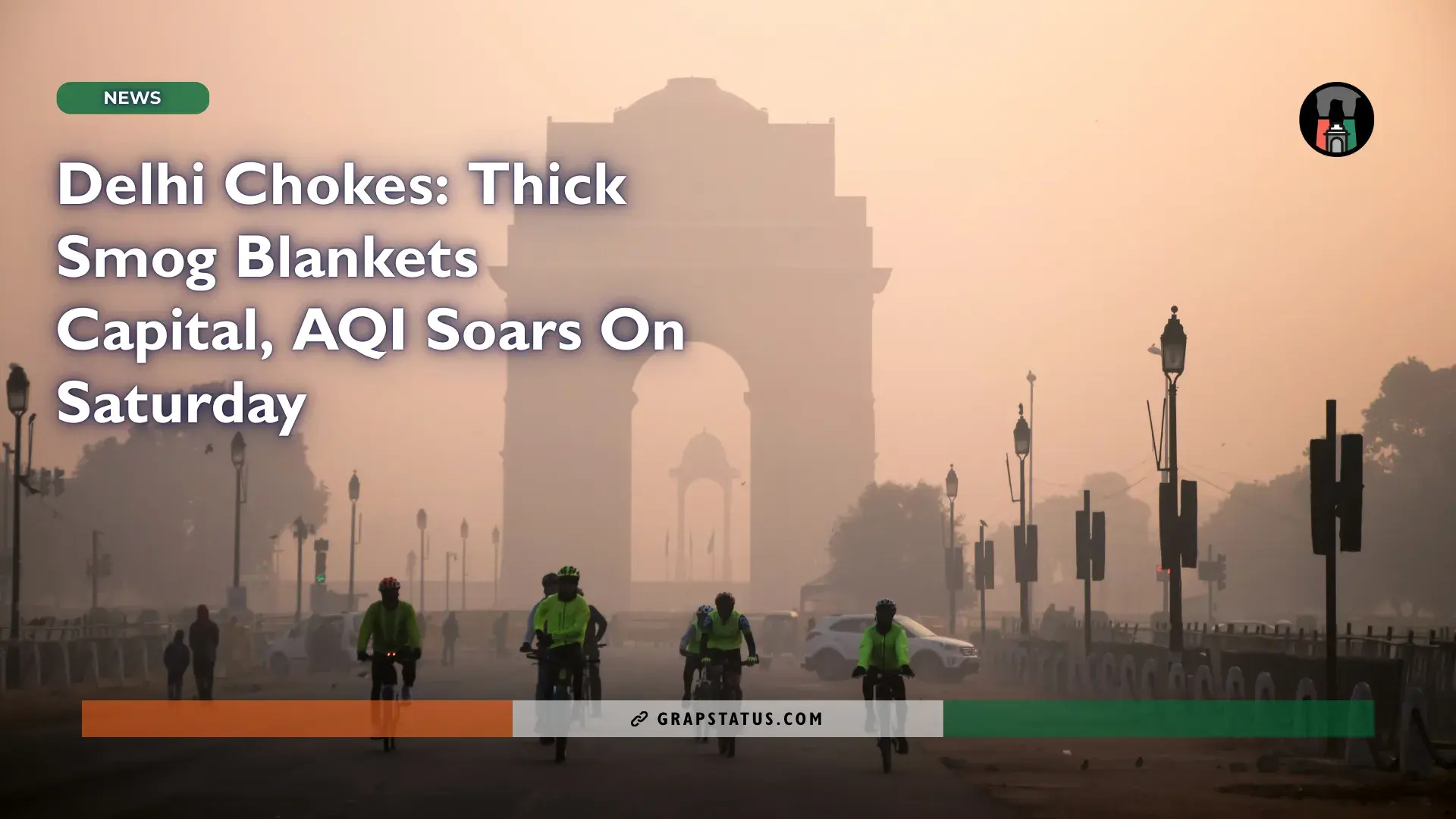
Delhi and its surrounding National Capital Region (NCR) woke up to another grim reality this Saturday as the air quality plunged deep into the “very poor” category. A dense, persistent layer of smog clung to the city, making the very act of breathing a health hazard. Across the capital, the Air Quality Index (AQI) values hovered in the low-to-mid 330s, confirming a widespread deterioration that has become an all too familiar and dangerous part of life for millions of residents.
Early morning data from the Central Pollution Control Board (CPCB) painted a worrying picture, showing Delhi’s overall AQI between 333 and 335. The primary culprit, as often is the case, was an alarming concentration of tiny particulate matter known as PM2.5. These microscopic particles, small enough to bypass the body’s natural defenses and enter the bloodstream, are the main driver of the region’s hazardous air.
The pollution wasn’t confined to a few pockets; it was a city-wide crisis. Out of 39 to 40 continuous monitoring stations, a staggering 35 to 36 reported “very poor” air quality. Only a handful managed to stay in the slightly less severe “poor” range, highlighting how broadly the air quality had degraded. Even prominent central locations, usually less affected, like India Gate and Kartavya Path, were shrouded in a toxic haze, recording AQI values near 311, still firmly in the “very poor” zone.
This level of pollution is not just an inconvenience; it poses significant health risks. According to the CPCB AQI scale, “very poor” air (301-400) means that prolonged exposure can trigger considerable respiratory and cardiovascular stress. This is especially true for sensitive groups such as children, the elderly, and individuals with existing heart or lung conditions, for whom the air turns into a silent, slow poison.

What Does “Very Poor” Air Quality Really Mean for Delhiites?
Understanding the AQI scale helps put the current situation into perspective. An AQI of 0-50 is considered “good,” 51-100 “satisfactory,” 101-200 “moderate,” 201-300 “poor,” 301-400 “very poor,” and 401-500 “severe.” So, an AQI hovering around 330-335 means we are squarely in the “very poor” category, just one step away from “severe.”
The primary concern is PM2.5, which the CPCB identified as the dominant pollutant across nearly all monitoring stations. These particles are less than 2.5 micrometers in diameter, about 30 times smaller than a human hair. They can penetrate deep into the lungs and even enter the bloodstream, leading to respiratory issues like asthma, bronchitis, and even long-term cardiovascular diseases. Current PM2.5 concentrations were around 90-100 µg/m³ and PM10 around 120-130 µg/m³. These levels are several times higher than the World Health Organization (WHO) 24-hour guideline for PM2.5, which emphasizes the extreme danger.
Where Were Delhi’s Air Pollution Hotspots on Saturday?
While the entire region suffered, certain areas bore the brunt of the pollution, pushing closer to the “severe” threshold. Localized hotspots significantly exceeded the city average, reflecting intense particulate loading in specific corridors. Stations in Mundka, Bawana, Anand Vihar, Ghazipur Mandi, Sonia Vihar, and Wazirpur recorded alarmingly high AQI values, ranging between roughly 352 and 387.
For instance, Mundka reported AQI values around 381-387, Bawana hit 375, and Anand Vihar and Ghazipur Mandi each touched 366. These locations, often industrial or traffic-dense areas, act as critical points where emissions are concentrated, making them particularly dangerous for residents. The fact that so many stations, including these notorious hotspots, were firmly in the upper “very poor” band underscores the challenge facing the capital.
Has Delhi’s Air Quality Been Consistently Bad This Week?
The air quality in Delhi has shown a troubling pattern of ups and downs throughout the preceding week, rather than a steady improvement. The city’s AQI started at 279 on Sunday, rose to 304 on Monday, and then spiked alarmingly to 372 on Tuesday, nearly touching the “severe” category. It then moderated slightly to 342 on Wednesday, dipped to 304 on Thursday, before climbing again to 327 on Friday, and settling around 333-335 on Saturday morning.
This strong intra-day and intra-week variability highlights that recurrent peaks are governed more by changing weather conditions and emission cycles than by any sustained reduction in pollution. High-resolution air quality platforms also recorded short-term nocturnal peaks, reaching “hazardous” levels—for example, around 364 at about 10 pm on the preceding night. This shows how quickly the air can become toxic, especially when atmospheric conditions are unfavorable for dispersion, and how daily activities like traffic and industrial operations shape these pollution profiles.
What Weather Conditions Are Trapping Delhi’s Pollution?
The current smog episode is largely supported by a specific combination of meteorological factors that act like a lid over the city, trapping pollutants close to the ground. Low temperatures, high humidity, and weak dispersion conditions create the perfect storm for pollution accumulation.
Minimum temperatures over Delhi were notably low, ranging between 6-8°C, which is about 2-3°C below normal. Maximum temperatures were around 21-24°C, indicating a significant drop in temperature overnight. This pronounced nocturnal cooling leads to the formation of stable inversion layers near the surface, preventing pollutants from rising and dispersing into the upper atmosphere. On Saturday morning, humidity levels soared to 95-100% before easing to around 68% by early evening. Such high humidity promotes fog formation, which further suppresses vertical mixing and allows fine particulate matter to accumulate.
A technical measure called the ventilation index, which combines mixing depth and wind speed, was forecast near 6000-6600 m²/s for the period. However, an Early Warning System for Delhi explicitly states that a ventilation index below 6000 m²/s, combined with mean wind speeds under 10 km/h, is highly unfavorable for pollutant dispersion. This means primary and secondary particulates are essentially stuck near the surface, unable to move away. Forecasts project that the air quality will remain in the “very poor” category for at least the next several days, suggesting persistent meteorological stagnation with little relief in sight.
Technically, what Delhi experienced is a classic “radiation-fog-cum-smog event.” This occurs when overnight cooling of the ground creates a shallow inversion layer. With high humidity approaching saturation and calm winds, the mixing layer depth—the atmospheric space available to dilute pollutants—shrinks dramatically. Under these conditions, continuous emissions from various sources lead to the sharp increase in fine particulate matter, both from direct release and from chemical reactions in the air.
What Are the Main Sources of Delhi’s Winter Smog?
The toxic mix blanketing Delhi is a result of multiple emission sources, all exacerbated by the unique meteorological conditions of late autumn and early winter. The main contributors include exhaust from the vast number of vehicles on city roads, emissions from industrial activities within and around the NCR, dust generated by ongoing construction projects, and critically, biomass burning. This includes local fires and, significantly, the regional transport of aerosols, particularly from agricultural residue burning in surrounding states like Punjab and Haryana.
This episode is part of the broader seasonal context of post-monsoon and early winter smog, when Delhi routinely records some of its worst air quality. This period is characterized by a confluence of low mixing heights, frequent temperature inversions, calm winds, and the episodic contributions from stubble burning. While government data highlighted that during 2025 no day had crossed the “severe plus” category, the city nevertheless spent extended periods in the “very poor” to “severe” bands, underscoring a chronic exposure problem rather than isolated extreme events.
Are Efforts Being Made to Combat Delhi’s Air Pollution?
In response to the persistent air pollution crisis, institutional frameworks are in place, primarily anchored by the Commission for Air Quality Management (CAQM) for the NCR. The CAQM oversees a graded response framework that imposes restrictions on activities such as construction, industrial operations, vehicular traffic, and biomass burning during high-pollution episodes. The current GRAP structure and its implementation are under constant review, with recent changes aimed at making the response more calibrated and effective across Delhi-NCR.
However, despite these measures, the persistence of AQI values in the 300-380 range clearly demonstrates that current interventions have not yet achieved the sustained reductions necessary to prevent the annual winter smog build-up. The city continues to grapple with a complex challenge, with no immediate meteorological trigger for rapid cleansing, such as strong winds or significant rainfall, expected in the short-term forecasts. While efforts continue, the reality on the ground highlights the urgent need for more impactful and long-term solutions to ensure breathable air for the residents of Delhi.